


When it comes to autism support animals, the difference between a service dog and an emotional support animal is not just a matter of terminology. It is a legal distinction that affects where your dog can go, what they are trained to do, how much protection your family has under the law, and ultimately how deeply that animal can be woven into the daily life of your child.
At Habibi Bears, we work with families navigating exactly this decision, and we know firsthand how much conflicting information is out there. This guide is here to cut through the noise, answer the questions that matter most, and help you understand which path is truly right for your family and your child.
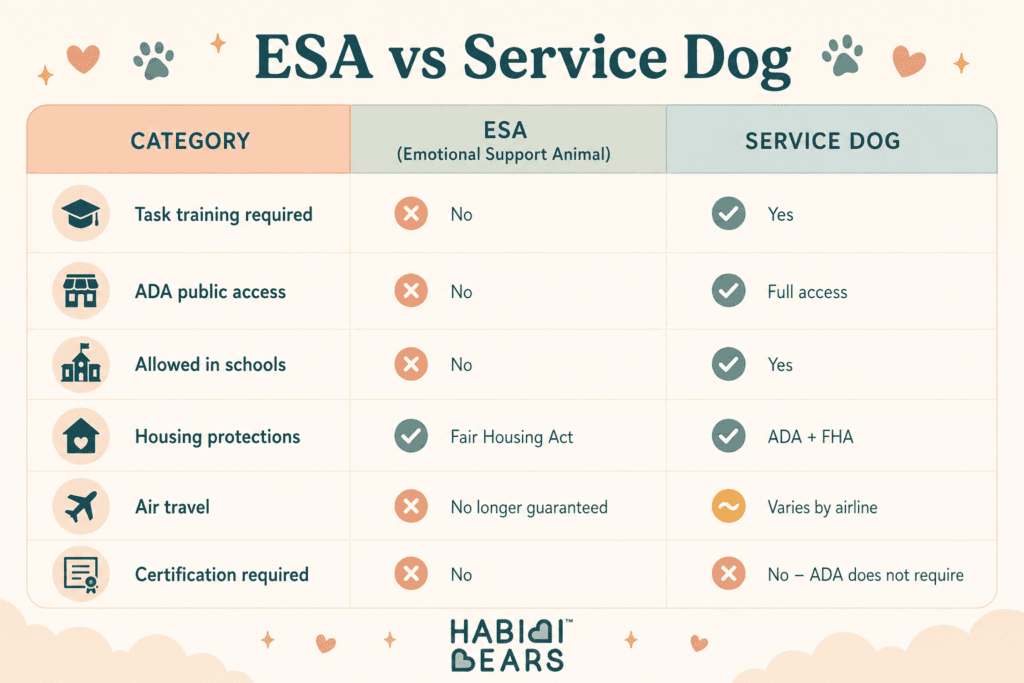
ESA vs Service Dog: A Quick Comparison
What Is a Service Dog?
A service dog is a dog that has been individually trained to perform specific tasks directly related to a person’s disability. Under the Americans with Disabilities Act, service dogs are legally protected and have full public access rights, meaning they can accompany their handler into restaurants, schools, stores, hospitals, and virtually any other public space, regardless of pet policies.
For children and adults on the autism spectrum, a psychiatric service dog might be trained to interrupt repetitive or self-harming behaviors, apply deep pressure therapy during moments of dysregulation, guide their handler away from an overwhelming environment, create a physical buffer in crowded or overstimulating spaces, or alert a caregiver to a shift in their child’s emotional state before a crisis escalates.
The keyword under ADA guidelines is task. A service dog does not simply provide comfort by being present. They perform a specific, trainable action that directly mitigates the effects of a disability. That distinction is what separates a service dog from every other category of support animal and grants them their legal protections.
It is also worth understanding that the ADA does not require a service dog to be professionally trained, certified by an outside organization, or registered in any database. The law is clear: the dog must be trained to perform a task related to a disability. How that training happens and who provides it are entirely up to the family.
What Is an Emotional Support Animal?
An emotional support animal, or ESA, provides comfort, companionship, and emotional stability to their person simply through their presence. They do not need to be trained to perform specific tasks, and they are not covered under the ADA in the same way service dogs are.
This means an ESA does not have public access rights. They cannot accompany their person into a restaurant, school, store, or any other public space unless the establishment chooses to allow it on their own terms. ESAs are protected in housing situations under the Fair Housing Act, which means landlords generally cannot deny a tenant their emotional support animal in a no-pet building, but that protection does not extend beyond the home environment.
For many families raising a neurodivergent child, an ESA can still be a deeply meaningful and loving presence. A calm, attuned dog at home can do remarkable things for a child’s nervous system regulation, their sense of safety, and their overall emotional well-being. However, if your child needs their dog with them at school, in therapy appointments, during medical visits, or out in the community, an ESA will not provide the legal framework to make that possible. Understanding this distinction early saves families from heartbreak later.
The Legal Landscape: ESA vs Service Dog Laws
Understanding the legal difference between these two designations is essential before making any decision, because the protections are not interchangeable and the gap between them is significant.
Under the Americans with Disabilities Act, a service dog is granted full public access in virtually all public and commercial spaces. Businesses and institutions may ask only two questions: whether the dog is a service dog required because of a disability, and what task the dog has been trained to perform. They cannot request documentation, ask for a demonstration of the task, require a vest or identification, or ask about the nature of the person’s disability.
An emotional support animal, by contrast, holds no ADA public access protections. The Fair Housing Act provides some protection in residential settings, and the Air Carrier Access Act previously offered protections for air travel, though those rules have been significantly narrowed in recent years, and most airlines no longer accommodate ESAs as they once did.
Some states have enacted their own laws that extend additional protections to emotional support animals, so it is always worth researching the specific rules in your state. But as a foundational principle, families should not assume an ESA will be welcome in spaces their child regularly needs to access.
Service Dog vs Emotional Support Animal for Autism: Which Is Right for Your Family?
This is one of the most common and most important questions families ask, and the honest answer is that it depends entirely on your child’s needs, your daily life, and your long-term vision for how your dog will support your family.
If your child needs their dog present in schools, therapy offices, medical appointments, or out in the community, a psychiatric service dog is the path that gives you the legal standing to make that possible. If your primary goal is to have a calm, deeply attuned companion who supports your child’s nervous system regulation at home and provides a consistent emotional anchor in a safe environment, an ESA may be a meaningful and appropriate fit.
What we know at Habibi Bears is this: the legal designation matters, but it is not the whole picture. The most transformative element is not the label the dog carries. It is the bond that was built before they ever came home. A dog who has been raised with nervous system awareness, whose earliest experiences were shaped around attunement and co-regulation, who has learned to read a child’s emotional landscape and respond with calm presence, that dog will serve your family in ways that go far beyond what any certification can define.
The Familiar Bond is not something that gets added on after placement. It begins during the imprint window, the most critical and irreplaceable phase of a dog’s development, and it is already being built by the time your Habibi Bear comes home to you.
Do ESAs Have Public Access Rights?
No. Under current federal law, emotional support animals do not have guaranteed public access rights the way psychiatric service dogs do. A business, school, restaurant, or public facility is not legally required to admit an ESA, and staff are within their rights to ask the animal to leave even if the family has a letter from a licensed mental health professional.
This is one of the most painful surprises families encounter when they have invested in an ESA without fully understanding the distinction. A child who has formed a deep bond with their dog and relies on them for regulation can be separated from that support in exactly the moments they need it most, simply because the legal foundation was not in place.
If public access is part of your child’s support plan now or in the future, it is worth building toward the service dog designation from the beginning rather than retrofitting it later.
Can an ESA Become a Service Dog?
Yes, and this is an important distinction that gives many families hope. The designation is based entirely on the dog’s training and function, not on a certification, a program, or a registration. If a dog is trained to perform specific tasks that mitigate the effects of a disability, they meet the legal definition of a service dog under the ADA regardless of what they were called before.

However, there is a deeper conversation to have here, one that sits at the heart of everything we do at Habibi Bears.
The foundational work that shapes a dog’s capacity for this kind of partnership, their nervous system resilience, their attunement to human emotional states, and their ability to remain calm and responsive in overwhelming environments happens during the imprint window. Those earliest weeks of life are when a dog’s brain and nervous system are most open to being shaped. A puppy raised with intention during that sacred window, handled with care, introduced to the rhythms of a family, taught through gentle and consistent guidance to read and respond to emotional cues, arrives already prepared for the deeper developmental work ahead.
A dog who missed that window can still learn tasks. But rebuilding what was not established in those early weeks is a longer, harder road, and some of what was available during the imprint window simply cannot be recreated later. This is why we are so intentional about what happens before your Habibi Bear ever comes home, and why the families who start with us are already ahead of where they would be starting anywhere else.
Are Service Dogs Legally Protected?
Yes. Under the Americans with Disabilities Act, service dogs are afforded full public access rights, and businesses are required by law to permit their entry. This applies to restaurants, retail stores, hotels, hospitals, schools, government buildings, and the vast majority of public spaces.
Staff may ask only two questions: whether the dog is a service dog required because of a disability, and what task the dog has been trained to perform. They may not ask for documentation, require a certification or ID card, request a demonstration of the task, or inquire about the nature of the handler’s disability. Any dog that meets the ADA definition of a service dog is protected, whether it came from a program or a trainer, or was owner-trained by the family.
This last point matters enormously for the families we work with. You do not need a program. You do not need a trainer. You have the legal right to guide this process yourself, with the right support, starting from the very beginning.
The ADA Self-Training Path: You Can Do This, and You Should
One of the most persistent and damaging myths in the service dog world is that a psychiatric service dog must come from an accredited organization, carry a price tag of $20,000 or more, and arrive fully trained after a waitlist that stretches two years or longer. Families exhaust themselves chasing a path that was never the only option available to them.
Under ADA guidelines, you have the explicit legal right to owner-train your own psychiatric service dog. This is not a workaround. It is not a lesser version of the real thing. It is a right that the law protects, and for families raising a neurodivergent child, it may actually be the most powerful path available.

Here is why. When a family purchases a fully trained, finished service dog, the dog arrives as an adult. The imprint window has long since closed. The foundational bond, the one that forms when a dog and a child grow and learn alongside each other during those earliest developmental months, was built with someone else. The dog is capable and trained, but the deep attunement that comes from shared experience during the most critical period of development is simply not there in the same way.
When you start with a Habibi Bear puppy, you are not starting from scratch. You are continuing a process that began before your puppy ever came home. The Familiar Activation Protocols, the nervous system foundations, the Sacred Signals work, all of it begins with us during the imprint window and continues with you as you step into the role of steward and guide for your child’s Familiar.
The Habibi Method Philosophy exists to make owner-training not just legally possible but deeply meaningful, practically supported, and genuinely achievable for families who never imagined they could do this themselves. You can. And the bond you build along the way will be something no finished dog and no outside program could ever replicate.
What the Imprint Window Means and Why It Changes Everything
We talk about the imprint window often because it is the single most important factor in determining what a dog can become, and it is the window that most families never even know exists until it has already closed.
The imprint window refers to the earliest weeks of a puppy’s life, typically from birth through approximately sixteen weeks, when the brain and nervous system are at their most receptive. During this period, experiences do not just shape behavior. They shape the dog’s fundamental capacity for trust, attunement, resilience, and emotional responsiveness. A puppy raised with intentional handling, nervous system awareness, and consistent loving guidance during these weeks develops a neurological foundation that supports everything that comes after.
This is not something that can be added on later. It is not something a trainer can install at six months or a year. It is built in those first weeks, or it is not built at all in the same way.
At Habibi Bears, this window is where our work begins. Every Habibi Bear puppy is raised from birth with the Familiar Bond in mind. By the time your puppy comes home, the bond has already begun, and we have been building it with them since day one.

Frequently Asked Questions
What is the difference between a service dog and an emotional support animal for autism?
A service dog is trained to perform specific disability-related tasks and has full public access rights under the ADA. An ESA provides comfort through presence alone and does not.
Can a family owner-train their own autism service dog?
Yes. The ADA explicitly protects a family’s right to owner-train their own psychiatric service dog without a program or outside trainer.
Does an emotional support animal have public access rights?
No. ESAs are protected in housing under the Fair Housing Act but can be asked to leave any public space that does not permit pets.
What tasks can a psychiatric service dog perform for a child with autism?
Tasks include deep pressure therapy, interrupting self-harming behaviors, creating a calming buffer in crowds, and alerting caregivers to emotional shifts.
Is certification or registration required for a service dog under the ADA?
No. The ADA does not require certification, registration, or professional training. Businesses may only ask two questions about the dog’s function.
Why does the imprint window matter so much for autism support dogs?
The imprint window is when a puppy’s nervous system is most open to shaping. What is built during those early weeks cannot be fully recreated later.
Can an emotional support animal be transitioned into a service dog?
Yes, if the dog is trained to perform specific disability-related tasks. The ADA designation is based on function, not on how the dog was originally categorized.
Areas We Serve
Families throughout Washington, Oregon, Idaho, California, Montana, and Arizona turn to Habibi Bears for educational resources about autism support dogs and companion animals. We frequently assist families in Seattle, Spokane, Tacoma, Portland, Eugene, Salem, Boise, Meridian, Coeur d’Alene, Los Angeles, San Diego, San Francisco, Phoenix, Scottsdale, Tucson, and neighboring communities.
Whether you are comparing a service dog to an emotional support animal, exploring legal protections, or deciding which option best fits your child’s needs, our goal is to provide clear, practical information that helps families make confident decisions. Every child and every family is unique, and understanding the differences between these support roles is an important step in finding the right path forward.