

How treating your dog like a human can hurt their confidence
Sometimes in our zeal and enthusiasm to show love and caring to our puppies, we might be tempted to treat them as little furry humans unwittingly. We love them so much, we even self-identify as puppy parents or call our puppies our fur babies.
We cannot fault you for having that type of overwhelming, all-consuming love for your pups, because we do too. But while we love our dogs to the moon and beyond, we understand that no matter how much we love them they are still canines and not human, so we consciously avoid anthropomorphizing them.
Love Your Dog Like Family, But Remember They’re a Dog – not a furry little human in a dog suit.
Anthropomorphizing is just a fancy word that means to attribute human traits or intentions to non-humans, in this case, your beloved puppies. Often with the good intentions of empathizing with a puppy who is struggling to self-soothe and learning to manage their anxiety, families can go too far and put themselves in the position of a puppy. While we always encourage empathy, to equate a normal juvenile canine developmental phase with our own complex emotions, perceptions or memories can only cause confusion at best, and lingering problems at worst. At the end of the day, your puppy remains a puppy and you will always be the human.
One of the most consistent examples of anthropomorphizing dogs is the all too common complaint we receive from our clients that their dogs don’t like being crated or confined in their pens.
- It’s so cruel to lock our puppy in a cage, he (or she) just hates it.
- My puppy just doesn’t like their pen, and I wouldn’t like it either if I were them.
- Our puppy cries until we let them out, which is proof to me they don’t like their pen.
Over the years we’ve heard every excuse about pens and crates, even though our pups are accustomed to their pens from birth. When they come to your home, they’re leaving the comfort of their littermates and encountering new people, smells, sounds and routines . This adjustment can feel scary, but consistent “together–alone time”—a core element of the Habibi Method—helps them learn to self‑soothe and adapt beautifully. If you stick to the guidance in our manual and provide gentle structure, the transition period will be smoother and shorter.
If your puppy struggles with being in their pens or crates, it’s time for honest self-reflection:
- Do I equate separation as incarceration or a punishment?
- Do I consider the puppy crate to be a bad thing or associate their pen with cruelty?
- Am I letting my personal opinions color my perception of how the pen or crate functions for my puppy?
- Is it possible my puppy is picking up on my ambivalence about being in a pen or crate?
Whether we realize it or not, our emotions and judgments can be picked up on energetically by our dogs, which adds to their resistance and hesitancy to stay nicely in their own area. Remember, because we don’t share the same language, dogs rely on the tiniest facial clues, body movements, breathing cadence and even vibes to read us. This means we have to take extra care to align with our objectives for our puppies so they don’t get mixed signals that could cause confusion or distress.
Some helpful tips:
- Be aware of your own anxiety and hesitation.
- Read up on the why of helping puppy self-soothe and the importance of being independent in their own private spaces.
- If you are anxious, remind yourself to breathe and ground your energy. Your pup will feel the shift and relax themselves.
- Remember to bring out “the good stuff” – the high value treats, stuffed Kongs, feeding puzzles with yummy treats- only the best things for their zen den time!
- Use a DAP diffuser and don’t forget about their own snuggle blanket- comforting smells can do lots of the work. Take advantage of your pup’s sense of smell to make them feel safe.
Because humans and dogs don’t share the same language, we are constantly striving to improve our methods of communication, both verbal and non-verbal, with our puppies, so that they in turn have the best understanding of their place in the world around them.
When puppies know their place and what is expected of them, they are able to function in a state of calm, their nervous system regulated. Once regulated, they are able to sleep well, follow a schedule, and cooperate with us in the home environment where we all can get along, humans and canine, making it a home sweet home indeed.
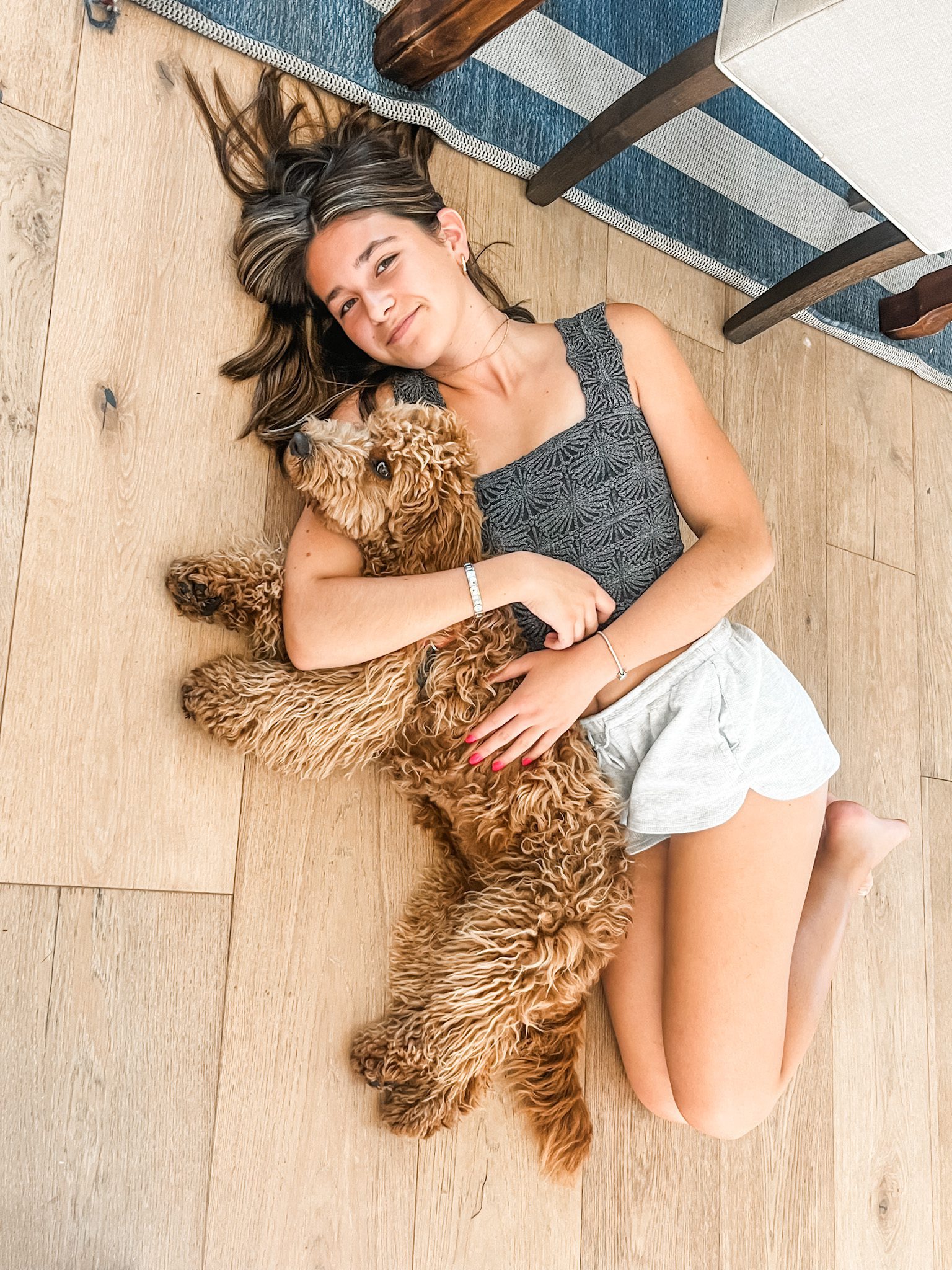
Luna & her Girl
Luna started out with a family whose emotions ran high and who struggled with many of the issues described in this article. Despite their love, they couldn’t provide the structure she needed, and Luna remained unsettled. When the family asked us for help, several members of the Local Habibi tribe quickly stepped in to find her a new home.
She soon joined a family committed to following our program, and the change was immediate. In their calm, consistent environment, Luna relaxed, learned what was expected of her and began to thrive. The photo of Luna with her new girl speaks for itself: she is content, confident, and at home.
Luna’s journey is a reminder that dogs learn from us. Our energy and the environment we create can make or break their confidence. When we provide the right kind of structure and avoid treating them like little humans, we set them up for success.