

Service Dogs for Autism: A Complete Guide for Families (2026)
Service dogs for autism are changing lives across the country, and if you have landed here, chances are you already feel in your bones that the right dog could be a game changer for your family. Maybe your child struggles with wandering. Maybe meltdowns leave everyone exhausted and heartbroken. Maybe you are watching your neurodivergent child move through a world that was not built for them, and you are looking for something that meets them where they are, not where the world expects them to be.
This guide was written for you.
We are going to cover everything: what service dogs for autism actually do, who qualifies, how to get one, what it costs, and the part most guides leave out entirely, how the right dog, raised with the right intention, can activate a bond so deep it changes the entire trajectory of your family’s story across homes in Washington, Oregon, Idaho, California, Montana, and Arizona.
Because that is what we have been doing at Habibi Bears for 37 years.
What Is a Service Dog for Autism?
Before we go any further, let us get clear on definitions, because this matters both practically and legally.
A service dog for autism is a dog that has been individually trained to perform specific tasks that mitigate the effects of a person’s disability. Under the Americans with Disabilities Act, service dogs are legally classified as working animals, not pets, and they have full public access rights, meaning they can accompany their handler to schools, restaurants, shops, hospitals, and anywhere else the public is permitted.
This is different from an emotional support animal, which provides comfort through companionship but is not trained to perform specific tasks and does not carry the same legal access rights.
The distinction matters, and we will come back to it.
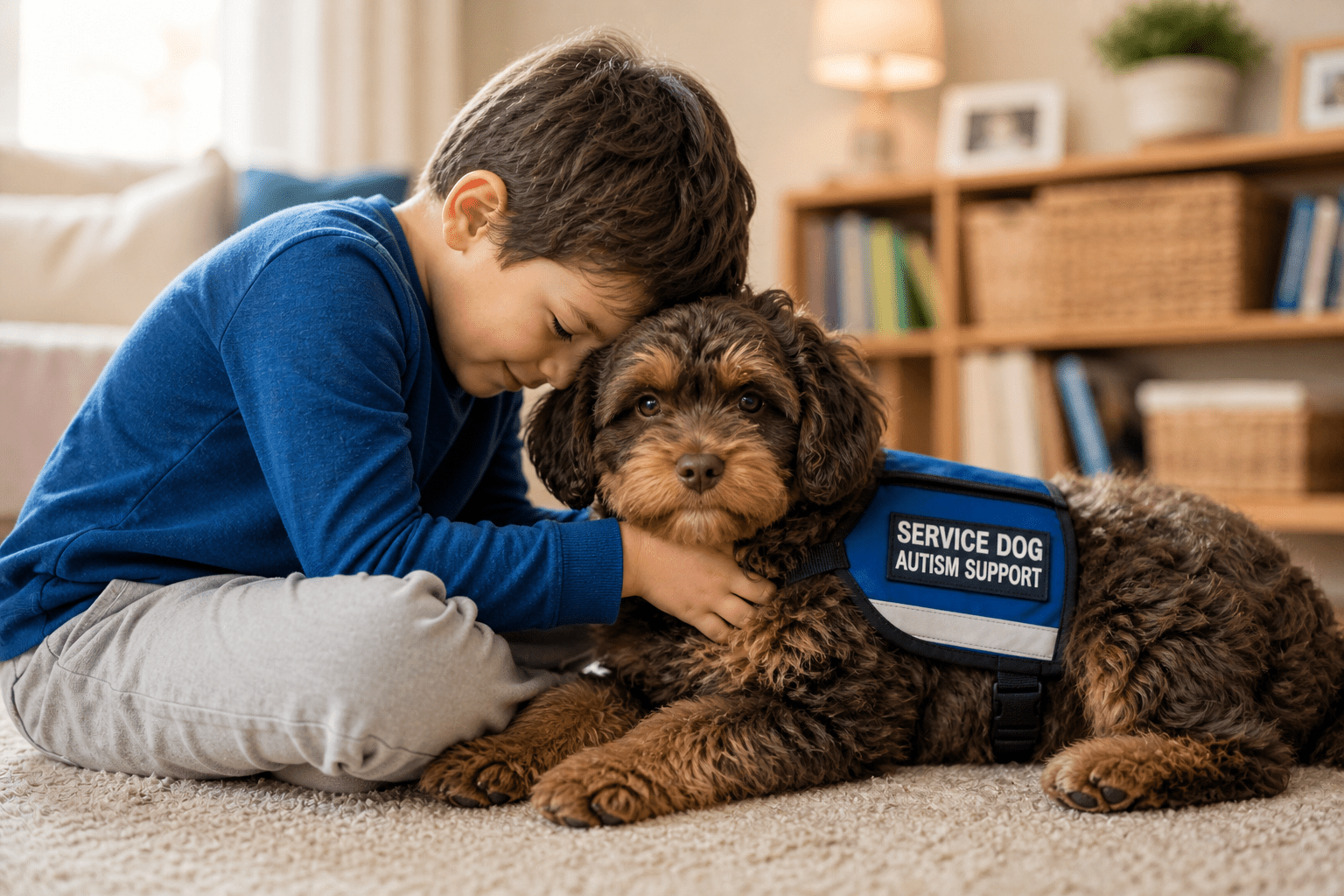
For autism specifically, service dogs are trained to address the functional challenges that autism can create in daily life: wandering and elopement, sensory dysregulation, meltdowns, social anxiety, disrupted sleep, and navigating public spaces safely, whether in Bellevue, Eugene, Meridian, San Diego, or Scottsdale. They are not there to fix your child. Your child does not need fixing. They are there to be a partner, a steady, attuned, living presence that meets your child exactly where they are.
Why Families Are Turning to Service Dogs for Autism
The research is growing, and so are the stories.
Families who add a well-matched service dog to their home report significant improvements in their child’s sense of safety, emotional regulation, and willingness to engage with the world. Parents report sleeping better because the dog provides an additional layer of awareness overnight. Children who struggled to connect with peers find that a dog becomes a social bridge, something other children want to talk about, approach, and be around.
But beyond the research, there is something harder to measure and impossible to ignore.
The right dog does not just perform tasks. The right dog attunes. They read the room before anyone else does. They move toward your child when the world is getting too loud. They offer a kind of presence that is unconditional, non-verbal, and completely without judgment, which, for a child who has spent their whole life being misunderstood, can be genuinely life-changing.
This is what we call the Familiar Bond. And it is the foundation of everything we do.
Snuggle Up to Your New Adventure
Connect with Us Today!
The Familiar Bond: What Makes This Different
At Habibi Bears, we do not see our dogs as pets. We see them as Familiars, sentient beings with their own intelligence, attunement, and capacity for sacred partnership.
This is not a marketing concept. It is a philosophy that has shaped 37 years of intentional breeding, and it is why our dogs are so naturally suited to working alongside neurodivergent children and adults.
Our breed was cultivated specifically for deep human attunement, calm nervous system regulation, and non-shedding coats that make them accessible to families managing sensory sensitivities and allergies. While Labrador Retrievers and Golden Retrievers are wonderful dogs, they were originally bred for hunting and retrieving, and they shed, sometimes significantly. Our dogs were bred from the beginning for one thing: profound, steady, attuned companionship.
When a Habibi is matched well with a neurodivergent child, what you witness is not a trained behavior. It is a relationship. A recognition. Something that looks, honestly, like two souls who were always supposed to find each other.
That is the Familiar Bond. And teaching families how to activate it is at the heart of everything we offer.
What Tasks Can Autism Service Dogs Perform?
Autism service dogs are trained to perform a wide range of tasks depending on the individual’s needs. Common tasks include:
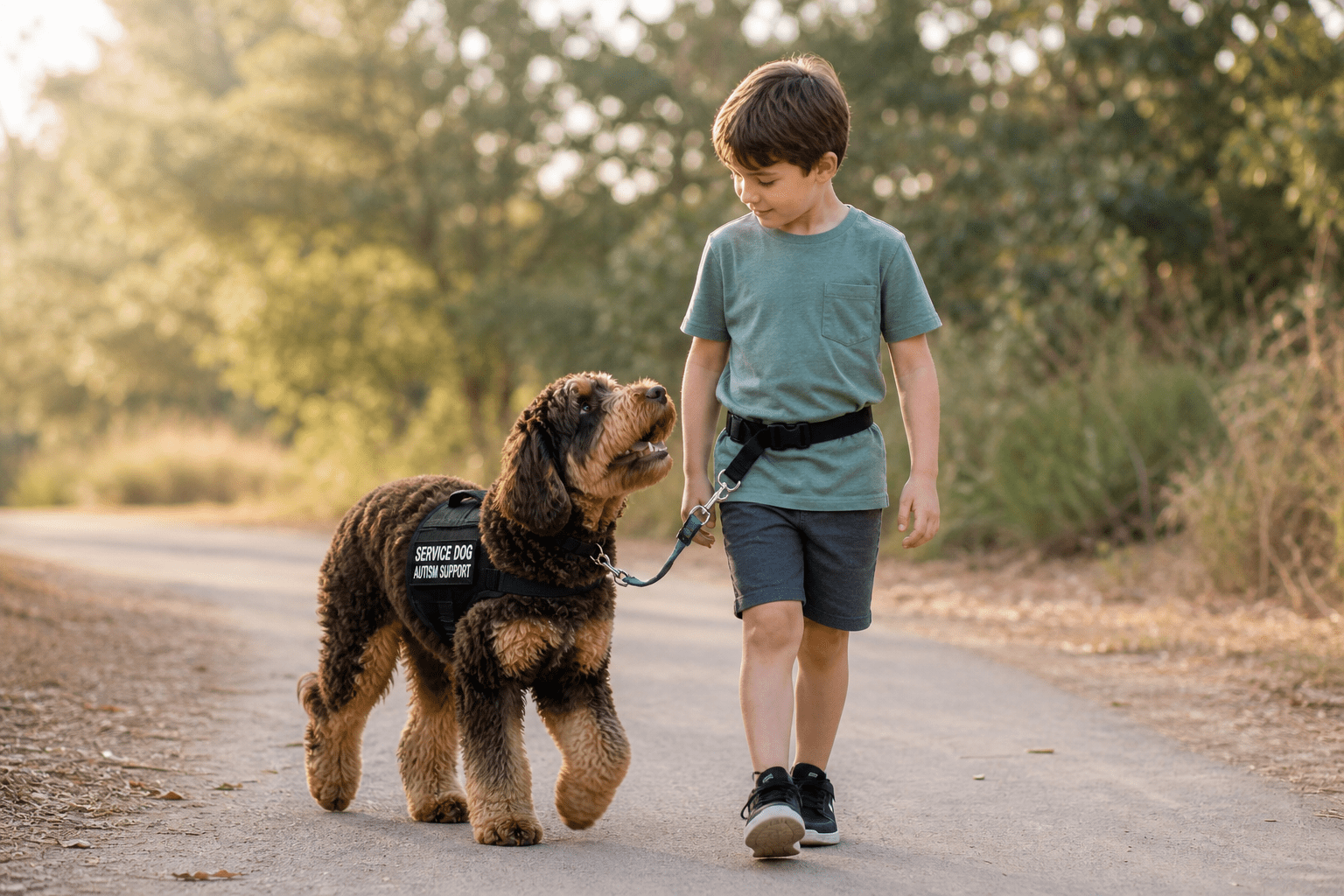
Safety and Elopement Prevention Many autistic children, particularly those who are drawn to water or who bolt in overwhelming situations, are at serious risk of wandering. A tethered service dog provides both a physical anchor and an early alert system, trained to interrupt movement toward unsafe areas or to track and locate a child who has wandered.
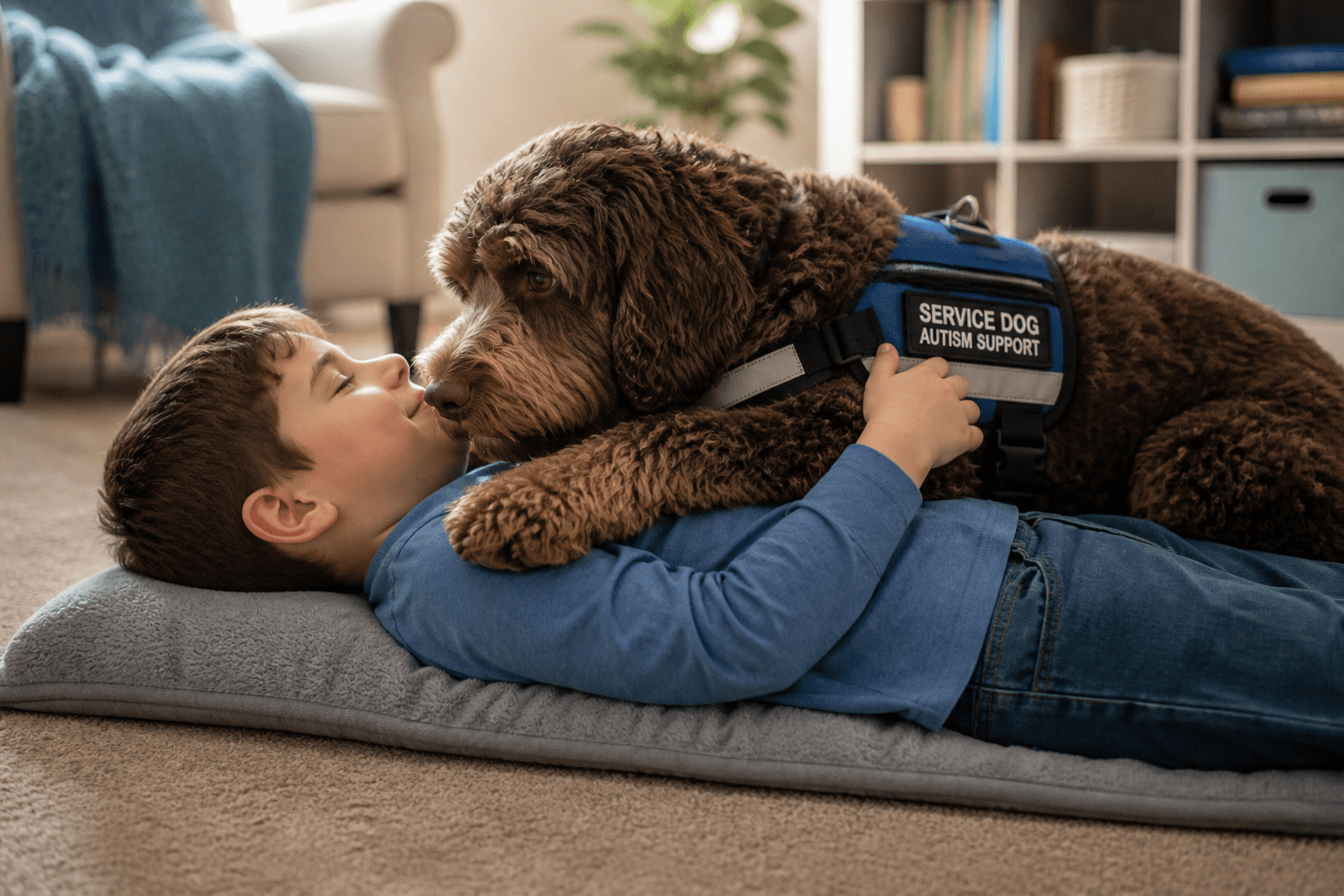
Deep Pressure Therapy A dog trained in deep pressure therapy will apply gentle, calming weight to a child’s body during moments of sensory overload or emotional distress. This proprioceptive input is one of the most effective natural tools for nervous system regulation, and dogs who are naturally attuned to their person often offer this without being asked.
Interrupting Meltdowns and Stimming Patterns A well-trained autism service dog learns to recognize the early signs of dysregulation and intervene before a meltdown escalates, using physical contact, nudging, or licking to redirect and ground their person.
Sleep Support Disrupted sleep is one of the most common and exhausting challenges for autistic children and their families. A service dog trained for sleep support provides a calming, regulating presence at bedtime, reducing anxiety and helping the child settle into rest.
Public Navigation and Social Bridging In overwhelming public environments, a service dog provides a point of focus and a sense of safety that allows many autistic individuals to participate in spaces that would otherwise feel impossible. The dog also acts as a natural social bridge, giving neurotypical peers and strangers a comfortable, neutral point of connection.
Who Qualifies for an Autism Service Dog?
Service dogs for autism are appropriate for both children and adults, though the process and considerations differ.
For children, most organizations and programs look for a formal autism diagnosis, though functional need is equally important. A child who is non-verbal, prone to elopement, or severely impacted by sensory processing challenges is typically considered a strong candidate. The family’s capacity to provide ongoing care, training consistency, and a stable home environment is also assessed.
For adults, the focus shifts more toward independence, daily functioning, and specific task needs. An autistic adult who struggles with public spaces, social anxiety, or self-regulation in high-stimulus environments may find a service dog significantly improves quality of life and autonomy.
The most important thing to understand is this: there is no single profile that qualifies or disqualifies a family. Every situation is individual, and the right match is about alignment, not a checklist.
How to Get a Service Dog for Autism: Your Options
There are three main pathways to getting a service dog for autism, and each has different timelines, costs, and considerations.
1. Apply Through a Nonprofit Service Dog Organization Many nonprofit organizations breed, raise, and train service dogs specifically for autism and then place them with families at reduced or no cost. Waitlists are typically long, sometimes two to five years, and the application process is thorough. Funding is often covered through donations, though families may be asked to contribute toward training costs.
2. Purchase and Train Through a Private Trainer Families can also purchase a dog privately and work with a certified service dog trainer to develop the specific tasks needed. This pathway is faster and allows for more personalization, but it comes with higher upfront costs and requires significant handler commitment.
3. Owner Training Under the ADA This is the pathway most families do not know is available to them, and it is the one we are most passionate about at Habibi Bears.
Under the ADA, there is no legal requirement for a service dog to be trained by a professional organization. An individual with a disability, or a family member on behalf of a child, has the right to train their own service dog. The dog must be trained to perform specific tasks that mitigate the disability, but the training itself can be owner-led with appropriate guidance and support.
This means that a family who starts with the right dog, a dog bred for attunement, calm temperament, and natural task aptitude, and invests in the right guidance and a qualified local trainer, can develop a genuine, legally recognized service dog relationship.
This is exactly what we help families do.
Why Habibis Are Exceptional for This Work
We want to be honest with you here, because this matters.
We are not a service dog organization. We do not train service dogs and hand them to families ready-made. What we do is something we believe is actually more powerful.
We have spent 37 years cultivating a line of dogs bred specifically for deep human attunement, emotional sensitivity, nervous system co-regulation, and steady, loving presence. These are not retrievers who have been redirected into service work. These are dogs whose entire genetic heritage points toward one thing: sacred partnership with humans.
When families come to us with a neurodivergent child, we do not just match them with a puppy. We look at temperament, attunement style, energy, and the specific needs of the child. Some of our dogs are natural deep pressure providers. Some are born trackers. Some have an almost uncanny ability to sense dysregulation before it becomes visible to anyone else in the room.
We then support families in developing the Familiar Bond, the foundation of the relationship, and connect them with qualified trainers in their area who can help formalize the task training required for ADA service dog status.
You get a dog bred for this work. You get the matching process. You get our guidance and philosophy. And you get connected to the right training support to take it all the way.
Hannah’s Heart and The Sirius Fellowship: Where This Work Goes Deeper
Not every family who needs this bond can afford it. That reality has always sat at the heart of what we do, and it is exactly why The Sirius Fellowship and Hannah’s Heart exist.
Hannah’s Heart is a 501c3 nonprofit outreach program of The Sirius Fellowship that donates purpose-bred Habibis for children in need. But it goes even further than that.
Hannah’s Heart offers scholarships and adoption assistance for families in need of an Autism Support or Psychiatric Support dog, as well as providing Courtroom Facility dogs to accompany a child in the courtroom when they testify.
Think about what that means for a moment. A child who has experienced abuse, a child who is terrified to speak, a child who might otherwise stay silent and let harm continue unchecked. Volunteers and their dogs help to empower child victims of abuse by escorting them into the courtroom where the Courtroom Facility dog sits with the child while they testify. If the child feels afraid, they have their loving companion nearby to pet and lean on through this experience. Many children may otherwise be too afraid to speak in court, but with their support dog by their side, they find the courage to speak their truth.
Teams are also available to sit in during depositions, therapy sessions, police interviews, or any situation where a child would need the calming presence and loving support of these dogs. Handlers sign a confidentiality agreement to ensure all statements remain confidential.
This is not a side project. The Sirius Fellowship now serves children in hospitals, courtrooms, and trauma centers, exactly what these conscious companions were created for.
The program runs entirely on a pay-it-forward model. Fund proceeds go 100% into direct service of those in need. The program is fully referral-based, with nominations submitted by community members who share a video explaining why a family deserves to receive a Hannah’s Heart scholarship.
Through the expanding nonprofit work of The Sirius Fellowship, the mission is building a world where every sensitive, gifted child has access to this kind of soul friendship.
If you want to support this work, every donation goes directly to a child who needs it. And if you know a family who should be nominated, we want to hear their story.
👉 Learn more and donate: www.siriusfellowship.org
👉 Nominate a family for Hannah’s Heart: habibibears.com/hannahs-heart-nonprofit
The Best Dog Breeds for Autism Service Work
This is one of the most searched questions in this space, and we want to give you an honest answer.
Labrador Retrievers, Golden Retrievers, and Standard Poodles are the breeds most commonly cited for service work, and they are wonderful animals. They are intelligent, trainable, and eager to please.
But here is what most guides do not tell you.
Labs and Goldens were bred for hunting and retrieving. Their instincts run toward independence, prey drive, and physical exuberance. Those traits can be channeled beautifully, but they require significant training investment to redirect toward calm, attuned service work. They also shed, sometimes heavily, which creates real challenges for families managing sensory sensitivities or allergies.
Standard Poodles are genuinely excellent and non-shedding, which is a significant advantage. But like Labs and Goldens, they were not bred specifically for deep human emotional attunement in the way Habibis have been.
What matters most in an autism service dog is not breed recognition. It is temperament, attunement, nervous system stability, and trainability. It is a dog that naturally moves toward a dysregulated child rather than away. It is a dog whose presence is inherently calming rather than stimulating.
After 37 years of intentional breeding, we know what that looks like. And we have been cultivating it in every litter.
Legal Rights and Public Access for Autism Service Dogs
Understanding your rights is empowering, and every family raising an autism service dog should know this information clearly.
Under the ADA, service dogs are permitted in all public spaces where their handler is allowed, including schools, restaurants, shops, hospitals, public transport, and hotels. Staff may ask only two questions: is this a service dog required because of a disability, and what work or task has the dog been trained to perform. They may not ask for documentation, certification, or a vest.
Schools fall under additional protections through IDEA and Section 504, which means families can advocate for their child’s service dog to accompany them in the educational environment. This is not always a simple process, but the legal right exists and is worth pursuing with appropriate support.
Emotional support animals do not carry these same rights. This is one of the most important distinctions families need to understand before beginning this journey, because the difference between an emotional support animal and a trained service dog affects where your dog can go and what protections your family has.
What Does an Autism Service Dog Cost?
Costs vary significantly depending on the pathway you choose.
Dogs trained and placed by nonprofit organizations typically cost families between zero and five thousand dollars, with the organization covering the rest through fundraising. However waitlists can stretch to several years.
Privately trained service dogs typically range from fifteen thousand to thirty thousand dollars depending on the level of task training and the organization providing it.
Owner training with a privately purchased dog is significantly more accessible. A well-bred Habibi, combined with ongoing handler training from a qualified local trainer, typically ranges from five thousand to ten thousand dollars total, making it one of the most realistic pathways for many families.
Funding options worth exploring include:
- Autism Speaks resource guides
- Local nonprofit organizations and foundations
- Medicaid waivers in some states
- Crowdfunding and community fundraising
- Service dog specific grants through organizations like 4 Paws for Ability and Canine Companions
Frequently Asked Questions:
Can a school deny my child’s service dog? Generally no. Under federal law, schools must make reasonable accommodations for service dogs. Individual situations may require advocacy and documentation, and working with a special education attorney can be helpful if you encounter resistance.
Are service dogs covered by insurance? Currently, most health insurance plans do not cover service dog costs in the United States, though this is an evolving area. Some FSA and HSA funds can be used toward service dog expenses depending on your plan.
Can I train my own service dog for autism? Yes. The ADA does not require professional training. Owner-trained service dogs are legal and valid as long as the dog is trained to perform specific tasks that mitigate a disability. We can help you find the right dog and connect you with qualified trainers in your area to support the process.
What if my child has sensory sensitivities to dog hair? This is one of the reasons families with neurodivergent children are drawn to Habibis specifically. Our dogs have low to non-shedding coats, making them significantly more accessible for children with sensory sensitivities or allergies. Thirty seven years of intentional breeding means we have also cultivated a temperament that is naturally gentle, calm, and easy to be around, even for children who are highly sensitive to energy and stimulation.
Do service dogs work for non-verbal autistic children? Yes, and often extraordinarily well. The relationship between a well-matched dog and a non-verbal child is one of the most moving things we witness in this work. The dog does not require language. It requires presence, and that is something every child has.
How long does it take to train an autism service dog? Task training for a service dog typically takes between one and two years depending on the complexity of the tasks, the dog’s natural aptitude, and the consistency of the handler’s training practice. Starting with a dog bred for attunement, as Habibis are, can significantly reduce the time and effort required to develop reliable task work because you are working with the dog’s natural instincts rather than against them.
Can adults with autism have a service dog too? Absolutely. Service dogs for autism are not limited to children. Autistic adults who struggle with public navigation, emotional regulation, social anxiety, or independent living often find that a well-matched service dog provides a level of support and freedom that other interventions cannot replicate.
How do I find a trainer to help me develop my dog’s service tasks? We can help with this. When you come to us through our application process, part of what we offer is guidance on locating qualified trainers in your area who understand both the ADA requirements for service dog task training and the relationship-based philosophy that underpins the Habibi Method. You do not have to figure this out alone.
Ready to Begin?
The right dog, raised with intention, matched with care, and welcomed as a true Familiar rather than a trained tool, has the potential to change everything for your family. Not because it fixes anything. Because it partners with everything.
Your neurodivergent child is not broken. They are wired differently, they feel deeply, they experience the world at a frequency most people cannot access. And the right dog does not just tolerate that. They meet it. They match it. They walk beside it without flinching.
That is what 37 years of cultivating this line has been building toward.
That is what Hannah’s Heart was created for.
That is what the Sirius Fellowship holds space for.
And that is what is waiting for your family on the other side of this application.
The next step is simple. Fill out our family application and tell us about your child, your home, and what you are hoping for. We will take it from there, with care, with intention, and with the kind of matching process that honors both your family and the soul of the dog that is meant to find you.
This is not a transaction. It is the beginning of a bond that, if you let it, will become one of the most significant relationships of your child’s life.
We have seen it happen more times than we can count.
We would love to see it happen for you.
👉 Begin Your Application Here Apply
👉 Learn More About Hannah’s Heart habibibears.com/hannahs-heart-nonprofit
👉 Support The Sirius Fellowship www.siriusfellowship.org
Written by Julie, Habibi Bears 37 years of cultivating the Familiar Bond, one sacred partnership at a time.