


Coyote Pupping Season: How to Keep Your Dog Safe and Coexist with Confidence
Every spring, coyote pupping season arrives across the United States, from the misty coastal hills of California to the wooded suburbs of the East Coast, and everything in between. Whether you live on the rural edge of a mountain town or walk your dog through a quiet neighborhood park, coyote pupping season is happening near you right now, and as a dog parent, a little knowledge goes a long way.
This is not a cause for fear. It is a call for awareness.
Understanding what is unfolding in the natural world around us is one of the most powerful things we can do to keep our companions safe. So let us take a closer look at what coyote pupping season actually means, what to expect when you encounter one, and how to move through it with the calm confidence your dog needs from you.
What Is Coyote Pupping Season and When Does It Happen?
Unlike domestic dogs, coyotes have only one breeding cycle per year. Breeding takes place in late winter, and after a gestation period of 60 to 63 days, pups are born in spring, typically between late March and May depending on your region.
Coyote pups arrive into the world blind and deaf, completely dependent on their mothers and their pack for survival. And here is something most people do not realize: coyotes are deeply social animals. Like wolves, they have community systems built around raising their young. Younger females help care for the pups, gaining experience for their own litters one day, while male coyotes patrol the perimeter of the den, keeping potential threats at a distance.
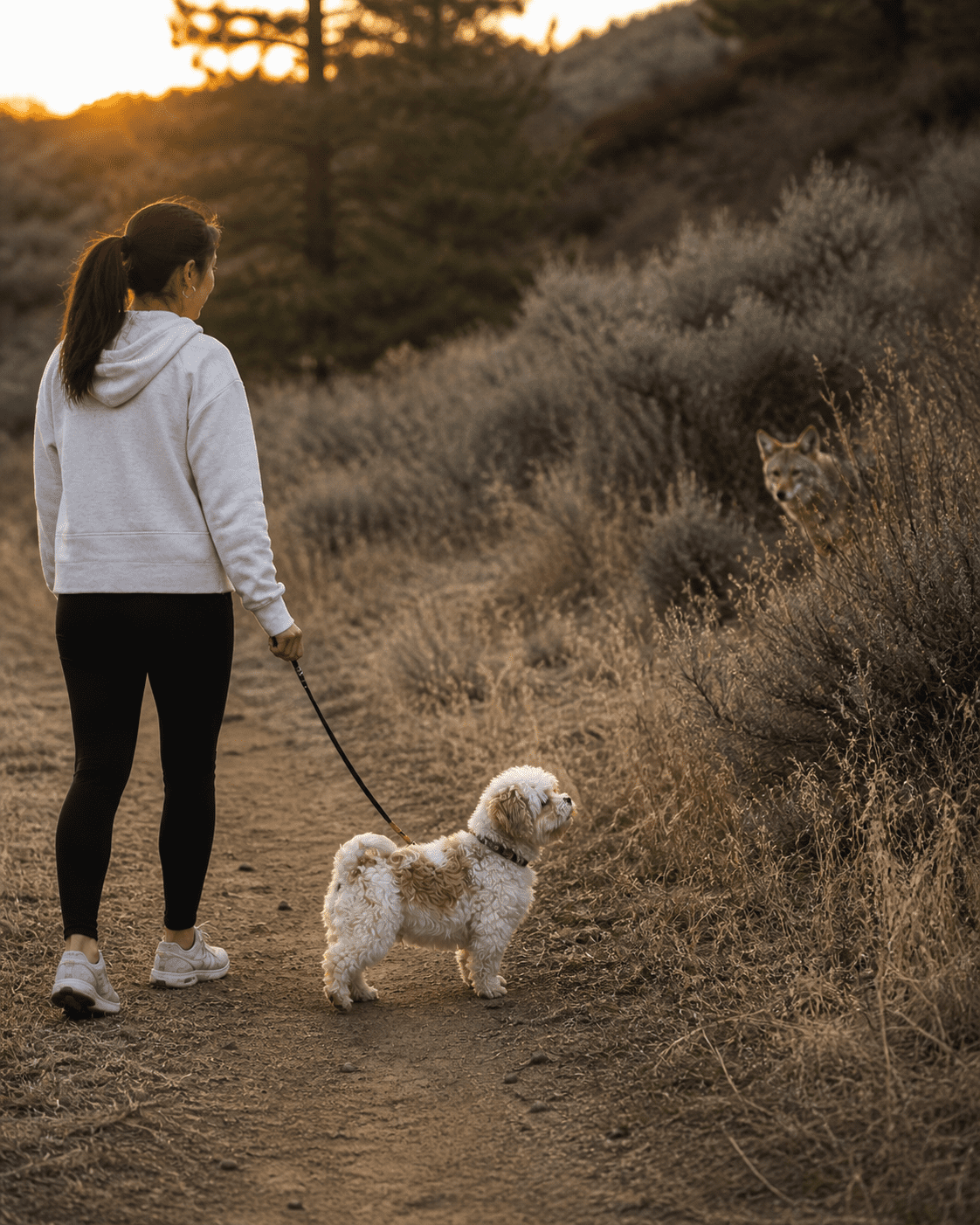
That last part matters. During coyote pupping season, a coyote who stands their ground, follows you, or appears to shadow your walk is almost certainly escorting you away from a den. They are not being aggressive in the predatory sense. They are being parents.
What It Looks Like When a Coyote Is Guarding a Den
Early one morning, while coastal fog was still sitting heavy over the Santa Cruz mountains, I was walking Junie, an eleven month old Golden Retriever in my care, along a quiet road on the edge of the suburbs. The hills were visible in the distance, the streets were silent, and the air had that particular quality that only early morning dog walks have.
As we crossed into a shaded stretch thick with royal oaks and coastal redwoods, something caught my eye. What I first thought was a loose cattle dog turned out to be a young, rangy coyote, somewhere between nineteen and twenty three pounds, standing completely still in the center of the road.
I stopped Junie. We waited. I clapped loudly and made a sharp sound to see if the coyote would move toward the dry creek bed just off the road. It did not move. It simply watched us.
That stillness told me everything I needed to know. There was almost certainly a den nearby, and we were the ones who needed to give way. I kept Junie close on a short wrapped leash, took a few calm steps backward, and then turned us around and changed our route entirely.
No drama. No confrontation. Just two species sharing a landscape with mutual respect.
That is exactly how it should go.
What To Do If You Encounter a Coyote on a Walk
If the coyote is simply moving through:
Keep your dog close on leash, note which direction the coyote is traveling, and plan to go a different way. There is no reason to create a confrontation where neither dog nor coyote needs to be involved—whether you are walking in Seattle, Spokane Valley, Portland suburbs, or Phoenix neighborhoods.
If the coyote freezes or moves toward you:
This is where hazing comes in. Make yourself large. Clap loudly, shout firmly, and hold your ground without advancing. Do not turn your back until you have created meaningful distance between yourself and the coyote.
Your goal is not to frighten or harm. Your goal is to communicate clearly that you and your dog are not prey and not a threat, and that the coyote’s attention is not welcome.
If you are in a rural or border area during coyote pupping season:
Consider carrying a shake can or sensory deterrent on your walks. In areas where coyotes have been spotted regularly, a repellent spray is a practical addition to your kit. During denning season especially, a coyote near pups may not respond to noise alone and may need additional discouragement.
Hazing vs Retreating: Knowing Which Approach to Use
The distinction here matters.
If a coyote is escorting you, meaning following at a distance or holding ground near what is likely a den, retreating calmly is often the most effective and respectful response. You are simply acknowledging that you have wandered too close to something sacred to them and you are moving on.
If a coyote is behaving in a way that feels genuinely bold or habituated, approaching without hesitation or showing no response to your presence, hazing is the appropriate tool. Bold behavior in coyotes is often the result of being fed by humans, intentionally or not, and hazing helps reinforce the natural wariness that keeps both coyotes and dogs safer in shared spaces.
Trust your instincts. You know the difference between an animal standing guard and an animal that has lost its natural caution. Respond accordingly.
Simple Ways to Coexist Safely All Season Long
Awareness is the most powerful thing you can bring to coyote pupping season. These simple habits make a real difference.
On your walks:
- Keep your dog on a leash at all times, especially at dawn and dusk when coyote activity peaks
- Stay alert to your surroundings rather than eyes down on your phone
- Vary your routes if you have had repeated sightings in one area
- Keep small dogs especially close on a short leash rather than a retractable one
At home:
- Bring in pet food and water bowls at night
- Secure garbage areas well, not because coyotes eat garbage directly but because it attracts other animals that coyotes follow
- Keep cats indoors during coyote pupping season, particularly at dawn and dusk
- Be especially vigilant with small dogs in yards, even fenced ones, during this season
In your neighborhood:
- Share information with neighbors about recent sightings so everyone can stay aware
- Never feed coyotes intentionally or leave attractants out
- Teach children what to do if they encounter a coyote while walking the family dog
We Can Share This World
Coyotes are not villains in our story. They are neighbors, adapting to the same shrinking wild edges that we are all navigating together. During coyote pupping season, they are simply doing what every good parent does, protecting the ones who cannot yet protect themselves.
With a little preparation, some calm awareness, and a healthy respect for what is happening in the natural world around us, we can be good neighbors. We can stay in our lanes, enjoy our morning walks, and avoid the kind of confrontations that nobody, human, dog, or coyote, actually wants.
An ounce of awareness is worth twenty pounds of regret.
Stay safe out there, and give your Familiar an extra squeeze from us. 🐾
Snuggle Up to Your New Adventure
Connect with Us Today!